Thursday, June 16, 2011

Sense and Sensibility Comparison: Part 3

The third part of the Sense and Sensibility Comparison by Miss Elizabeth Bennet from Elegance of Fashion and Melody from Regency Delight ~ Jane Austen, etc.

Lucy/Edward Engagement Revealed
1995 Scene
Miss Bennet: Since there was no Anne to reveal the engagement to Fanny, the 1995 scene is different from the book. In the 1995 version, Lucy and Fanny are talking and, until Lucy gains Fanny's confidence that any rich family would want her to marry any of their sons, Lucy tells Fanny that she is engaged to Edward and Fanny is thrown into hysterics. This wouldn't seem like Lucy to tell Fanny about the engagement since Lucy is so cunning. She may have told Elinor about the engagement, but it wasn't because she needed to get it off her mind, but rather because she was jealous that Edward might love another woman.
Melody: Since there is no older sister in this version to spill the beans, they had Lucy tell Fanny herself that she was engaged to Edward. After testing her ground a little, she whispered it – but apparently Fanny thought much more of Lucy as her little protégée than someone who could be a suitable sister-in-law for her. She screams and causes a commotion that makes Lucy fall to the ground, then Fanny pulls Lucy up, yelling and acting like a maniac…it was really quite funny.
2008 Scene
Melody: Now this one was more like the book. Anne/Nancy/Miss Steele is sitting in the parlor with Fanny and Mrs. Farrars, where she casually talks about Edward and Lucy seeing much of each other – and then about their long-standing engagement. It suddenly dawns on Miss Steele that, oh yes, that was supposed to be a secret, and Fanny becomes enraged. Right after that, Edward himself enters with Lucy…Mrs. Farrars questions Edward, and Miss Steele says to Lucy “I’m sorry, it just popped out!” Now in the book, instead of actually having this scene, it just has Mrs. Jennings telling Elinor about it. Mrs. Jennings said: “Poor Nancy, who, you know, is a well-meaning creature, but no conjurer, popt it all out.” I like how they took that quote and put it into the scene.
Miss Bennet: Much closer to the book! Since Anne was in this version, Anne was the one to, as she put it in the miniseries, "[pop] it out." I really liked this scene since it was comical and funny. If I remember correctly, however, I don't think Mrs. Ferrars was in the room at the time in the book, but she was present in the miniseries.
 Overall
Miss Bennet: The 2008 version. I love that scene!
Melody: As much as I enjoyed the scene from 1995, my favorite is the one from 2008. It’s more realistic – with all her precautions for secrecy (ulterior motivated though they may have been), I doubt she would just tell Fanny, especially without talking to Edward – and in any case, it’s not what happened in the book.

Colonel Brandon/Willoughby Rivalry
1995 Presentation
Miss Bennet: I think the movie was a little more accurate to the rivalry. Towards each other, for the most part, both Colonel Brandon and Willoughby were polite to each other, though neither of them liked the other. Willoughby had some unkind remarks about Colonel Brandon while he wasn't around, which was what it was in the book.
Melody: This version didn’t show much of rivalry between the two…the first time they are seen with each other on the movie, Col. Brandon is walking away from Barton Cottage and Willoughby is walking towards it…Col. Brandon looks back at him rather suspiciously. They meet in the same circles several times and Brandon looks displeased about Willoughby’s attentions to Marianne. In London, he tells Elinor of Willoughby’s evil deeds, and that’s pretty much it.
2008 Presentation
Melody: In this one, they really decided to play up the Willoughby/Brandon rivalry element. It has a similar scene to 1995…Willoughby is visiting Marianne the next day after she’d fallen, and Col. Brandon comes in while Willoughby is still there. But rather than having Willoughby cordially but perhaps slightly coldly greet Col. Brandon, he gets on his mad face and that mysterious music starts up and then the episode ends. Later, at a ball, Col. Brandon asks Willoughby what his intentions are towards Marianne. Finally, after Col. Brandon finds out the whole of Willoughby’s villainies, he takes him out and has a duel. I thought that was a little strange. They say they got it from the book, though, and I suppose it could be alluding to something of the sort (it was when Brandon was talking to Elinor in London), but it never mentioned swords.
Miss Bennet: In this adaptation, they film-makers really expanded on the Colonel Brandon/Willoughby Rivalry. Scenes were added, such as Colonel Brandon calling Willoughby in private to ask about his intentions towards Marianne and the sword fighting duel (though there was a duel in the book, it was only briefly mentioned by Colonel Brandon). From the start, both did not like each other and didn't really hide it.Cottage).
 Overall
Miss Bennet: I like the way the rivalry was presented in the 1995 adaptation better. It was closer to the book, and sometimes less is more.
Melody: I’m not sure I’ve exactly seen Brandon and Willoughby as rivals….Willoughby is the bad guy, and the Colonel is the good guy. So I suppose I prefer the 1995 version. I just didn’t like the way they went about it in the 2008 version…
Endings
1995 Scene
Miss Bennet: The movie ends with Colonel Brandon and Marianne getting married. Elinor and Edward's marriage is not shown, so it's implied that they already got married, Edward became a clergyman, and he presided over Colonel Brandon and Marianne's wedding. Because of all these implications, it was believed that it was a double wedding, but Edward and Elinor were already married for two years. They also included Willoughby looking on at the wedding, regreting that he didn't marry Marianne.
Melody: This one goes directly from the scene of Edward’s proposal to the wedding of Col. Brandon and Marianne. I love the music for that part, it makes me feel happy…
2008 Scene
Melody: The very ending of this movie shows Col. Brandon carrying Marianne to their new home…and Elinor and Edward at their cottage, with Edward chasing chickens and they are both laughing…
Miss Bennet: No wedding was shown, but there is a little insight shown into what happens after everyone gets married. They show what appear to be remnants a wedding for Marianne and Colonel Brandon and Marianne and Colonel Brandon immediately after the wedding; Marianne is shown to really love Colonel Brandon. Elinor and Edward are shown keeping a couple of chickens with Edward chasing after the chickens and Elinor watching and laughing and truly happy.
 Overall
Miss Bennet: They're both great endings! Though I am partial to a wedding, I liked the 2008 version a little more. Again, another close call...
Melody: I like the 1995 version’s ending better. What can I say? I like things that end with weddings. ;-) The 2008 version had Marianne tell Elinor she was engaged to Col. Brandon before Elinor had even seen Edward again…in the book, Elinor had been married for quite some time before that. I did like it that they showed more of Marianne being with Col. Brandon more…in the 1995 version, it seemed like they really rushed through (or past) it.


Navigate to the Different Parts of the Sense and Sensibility Comparison!
Part 1
Part 2
Part 3
Part 4

Wednesday, June 15, 2011

Sense and Sensibility Comparison: Part 2

The continuation of the Sense and Sensibility Comparison by Miss Elizabeth Bennet from Elegance of Fashion and Melody from Regency Delight ~ Jane Austen, etc.

Margaret Dashwood
Emilie François (1995)
Miss Bennet: Emilie François's Margaret was a couple of years younger than she should have been (Margaret is 11 in this version, but in the book she's 13). There was more of her in the movie than there was in the book and they developed her relationship with Edward more than they did in the book.
Melody: Margaret is a character who wasn’t much talked about in the book. In this movie, they made Margaret be almost tomboy-ish, with her sword-fighting and climbing trees. In the book, she was supposed to be rather like Marianne only younger, and I can’t say this Margaret was. Rather than being a tomboy though, I think she just had an interest in the outside world…she was always looking at the atlas, and pretending to go different places. During the movie she said she was going to be twelve soon; in the book she’s supposed to be thirteen at the beginning. She’s very funny though, and has some very quotable lines.
Lucy Boynton (2008)
Melody: Again, since there wasn’t much said about Margaret in the book, they pretty much had to make up their own stuff for her. This Margaret had some of the same traits as the other – hiding and sitting in trees, but she had very different interests. I’m glad they gave her more lines and such – I wish there was more about Margaret in the book. The 1971 and 1981 versions left her out altogether; how sad!
Miss Bennet: Lucy Boynton's Margaret seemed to be closer to Margaret's age. They seemed to develop her character more than they did in the book and in the 1995 movie (she aspires to be a writer). And (as with the 1995 movie), her and Edward develop a friendship that wasn't in the book.
 Overall
Miss Bennet: Though they were both very similar, I liked Lucy Boynton's Margaret a little better; she was a little more mature than Emilie François in the role of Margaret.
Melody: I prefer Miss Lucy’s Margaret. She seems more of what I’d imagine from reading the book.

Mrs. Dashwood
Gemma Jones (1995)
Miss Bennet: Gemma Jones's Mrs. Dashwood was older than she is in the book (I believe Mrs. Dashwood was supposed to be in her forties, while this Mrs. Dashwood had grey hair). Her Mrs. Dashwood was emotional, which is how she is written in the book. Other than that, I don't have much to say about Gemma Jones's Mrs. Dashwood.
Melody: Now the book doesn’t say much about her, but sort of said that Mrs. Dashwood is like Marianne only older. I think she did a good job. I love the part where one by one everyone goes into their room to cry and Elinor is left in the hallway to drink the tea…
Janet McTeer (2008)
Melody: This Mrs. Dashwood seems different than the other one. She was younger, for one thing. (She still wasn’t 40, like the book says. Although, since Elinor was supposed to be older in the 1995 version, she wouldn’t have been 40 anyways.
Miss Bennet: Janet McTeer's Mrs. Dashwood seemed to be the right age for Mrs. Dashwood. I liked her performance, but maybe she could have been a little more emotional (although there were scenes in which her actions were emotional, like when she wanted to write a letter to Edward to get him to visit Barton Cottage).
 Overall
Miss Bennet: This is tough! I liked both... I think that I liked Janet McTeer's Mrs Dashwood a little bit more, but it's a very close call.
Melody: I really don’t have a preference; I like both. If I had to choose, I guess I’d pick Janet McTeer.
Anne and Lucy Steele
Imogene Stubbs (1995)
Miss Bennet: It was a little disappointing that they didn't include Anne in the 1995 adaptation of Sense and Sensibility.  Imogene Stubbs was a good Lucy Steele, though: she got (for lack of a better term) the whole "I'm nice to Elinor but I'm really gloating at her" thing well.
Melody: I like this Lucy. I mean, I don’t like this Lucy…I mean, she does a good job. She seems very sly and…Lucyish.
Daisy Haggard and Anna Madeley (2008)
Melody: Since this Lucy has a sister, it makes the whole thing different…and they make quite the interesting pair. Anne (Nancy) Steele with her constant chatter about “beaux” and then of course she is the one who tells the Farrarses that Lucy is engaged to Edward…”It just popped out!”, it makes it quite comical. As to Lucy herself, she seems to act more quiet towards the beginning, probably because she has an older sister who talks a lot. She seems to present herself as more demure than Imogen Stubbs.
Miss Bennet: Ah yes! Anne is finally here! Daisy Haggard was really funny as Anne Steele! The way she rambles on is very humorous and the way it was acted would be something that Jane Austen would have written. Anna Madeley's Lucy was good, but to me it seems that there should have been something more to her... I just can't place what...
 Overall
Miss Bennet: Well, I really like that the 2008 version included Anne, but I like Imogene Stubbs's Lucy a little better... If I had to pick one, I would probably pick the 2008 version since the inclusion of Anne really stood out to me, but this was a really close call for me.

Melody: I like both Lucys, although my favorite is the one from 1995. There’s just something about her that really catches her…villainess-ness. However, I really like the fact that they included Anne in the 2008 version, so that's a few more points for them.

Mrs. Jennings
Elizabeth Spriggs (1995)
Miss Bennet: Elizabeth Spriggs's Mrs. Jennings was how I would have pictured her in the book: jolly, silly, and a matchmaker. Mrs. Jennings was one of the characters that Jane Austen used for satire, so she had to be silly. Between Mrs. Jennings and Sir John laughing trying to guess Elinor's beau and her attempts at trying to set a match between Colonel Brandon and Marianne towards the beginning, Elizabeth Spriggs was a great Mrs. Jennings!
Melody: Loud, laughing, and robust, this woman makes quite the impression. I love the scene where they’re all sitting at the table, and from Margaret’s unwise hint, are trying to guess last names that start with ‘F’.

Linda Bassett (2008)
Melody: Mrs. Jennings is always a funny character, only the worst actress could un-funny her, so naturally I liked this Mrs. Jennings, too. However, there seemed to be a little something missing…
Miss Bennet: Linda Bassett's Mrs. Jennings was caring and silly enough to annoy Marianne, but I think she could have been sillier. Mrs. Jennings is supposed to be a comical character, but here she was portrayed as being more dignified than she was in the book. 

Overall
Miss Bennet: Elizabeth Sprigg's Mrs. Jennings. Her version was closer to how I would have pictured Mrs. Jennings in the book.
Melody: Elizabeth Spriggs is my favorite. She seemed to be the best as the funny, teasing, slightly meddlesome woman in the book. Side note: When I read the book, I remember laughing at a part where Mrs. Jennings thought that Elinor was engaged to Col. Brandon – it would have been so funny in a movie, and none of them included it!

Fanny Dashwood


Harriet Walter (1995)
Miss Bennet: Harriet Walter's Fanny was very good! I thought that she captured Fanny's condescending personality well with the way her voice was and the way she said it.
Melody: Annoying Fanny. She did it well. Both the Fannys seem to have curls plastered on their heads that look like sliced olives…especially with her though, because her hair is dark.
Claire Skinner (2008)
Melody: I have no negative comment to make—they are both very good at being annoying. This one seems to act especially snobbish and thinks herself is really great.
Miss Bennet: Claire Skinner, to me, sort of missed the mark with Fanny. There were some parts in which I thought she was more of a comical character than a condescending one. I never thought of Fanny as being a comical character, just an uncaring one.
 Overall
Miss Bennet: I much prefer Harriet Walter's Fanny to Claire Skinner's. Harriet Walter seemed to capture the Fanny that I pictured better than Claire Skinner.
Melody: This is a hard decision. They are both very irritating, snobby, and controlling—but I suppose if I had to go with one, I’d go with Harriet Walter.

Navigate to the Different Parts of the Sense and Sensibility Comparison!
Part 1
Part 2
Part 3
Part 4

Tuesday, June 14, 2011

Sense and Sensibility Comparison: Part 1

 Sense and Sensibility was the first of Jane Austen's novels to be published two hundred years ago. It has been adapted multiple times within the last fifty years. The two most recent adaptations are probably the best known by fans. The 1995 movie starring Emma Thompson and Kate Winslet was beloved when it came out and even won some awards. Thirteen years later after Emma Thompson's Sense and Sensibility, in 2008 another version came out starring Hattie Morahan and Charity Wakefield. Since these two adaptations are the most well known among Austen fans, they are often compared. This is where this post comes in. Miss Bennet from Elegance of Fashion and Melody from Regency Delight~Jane Austen, etc. will voice their opinions on the different aspects of each adaptation and then pick which one they prefer at the end!

Elinor Dashwood

Emma Thompson (1995) 
Miss Elizabeth Bennet: Emma Thompson's Elinor had a quiet demeanor. She did a really good job showing that Elinor had emotions, even though she had to hold them back. In the book, Elinor has a lot of deep feelings, but she doesn't bluntly show them; this is what Emma Thompson's performance exhibited. The only downfall to her Elinor was that she was in her mid thirties at the time, so she was a little too old to play Elinor (I heard that Ang Lee, the director, wanted Emma Thompson to play the role of Elinor, so he changed Elinor's age from 19 to 27).
Melody: As it is Emma Thompson who wrote the script, she seemed to really have a good feel for the character. She was too old...36 or something like that...and so they changed Elinor's age to mid-twenties, when in the book she's supposed to be 19 at the beginning. But that aside, it was well done.

Hattie Morahan (2008) 
Melody: I thought Hattie Morahan's Elinor was tolerable enough, but there was something about her... I picture Elinor as somebody prettier than she was, and she was too old too. 
Miss Elizabeth Bennet: Hattie Morahan's Elinor was a little bit louder than Emma Thompson's quiet Elinor. It's a plus that Hattie Morahan is closer in age to Elinor than Emma Thompson was. She did a good job with Elinor's calm nature and hiding her emotions, but she sometimes comes off as if Elinor doesn't have many emotions. She probably could have shown that she has emotions a little bit more than she did.

Overall
Miss Elizabeth Bennet: I like Emma Thompson's Elinor a little bit more than Hattie Morahan's. I can see Elinor as being more of a quiet person and I love how Emma Thompson was able to show so much emotion in a restrained manner.
Melody: I liked them both, but I suppose Emma Thompson's Elinor was my favorite. 

Marianne Dashwood
Kate Winslet (1995)
Miss Elizabeth Bennet: Kate Winslet is a tad older than Marianne should be (Marianne was 16, while at the time, Kate Winslet was 20), but I think she nails Marianne pretty well. Sometimes she might get a little over-the-top with the emotional side of Marianne, but I think that it works because Jane Austen's intent was to show how over-emotion isn't a good thing and to satirize the over-emotion that was popular in many novels of that time period.
Melody: I liked her. She seemed to have a good feel for the dramatic way Marianne is supposed to be. 

Charity Wakefield (2008)
Melody: Sometimes I liked the way she looked better than Kate Winslet, but there was something wanting in her Marianne-ness. She looked young... She wore her hair down sometimes, and I don't think that would have been quite appropriate...though since she was only 17 near the beginning, I suppose she may be excused a few times. (Lady Middleton, however, wore her hair down, and there can be no excuse for that...)
Miss Elizabeth Bennet: Charity Wakefield (who at the time was actually 27) was much older than Kate Winslet when she played Marianne. I thought that she needed to play Marianne with a little more emotion; she seemed restrained some of the time with her emotions which wouldn't be like Marianne.

Overall 
Melody: Hmmm....hmm....this is one I've always been arguing with myself about. I like them both in differnet ways. I suppose I shall go with Kate Winslet. Charity Wakefield's hair, though, was at least closer to brown than Kate's (in the book I think Marianne has dark hair and eyes)
Miss Elizabeth Bennet: Of the two, I perfer Kate Winslet's Marianne. I didn't dislike Charity Wakefield's Marianne, but she needed to play up the emotional aspect of Marianne a little more.

Edward Farrars
Hugh Grant (1995)
Miss Elizabeth Bennet: I did not like Hugh Grant's appearance throughout the movie. He nearly looked sickly! Of course, I've never really cared for his appearance. His being cast as Edward Ferrars had caused some concern for some since they thought that he was too good-looking for the role, but since I don't really find him good-looking and since Edward Ferrars isn't supposed to be, I think that wouldn't have have been a problem. Other than that, I thought that he acted Edward pretty well: Edward is supposed to be shy, which I think he did well.
Melody: The 1995 version was the first one I saw, and I didn’t dislike the Edward. After reading the book, Hugh Grant seemed a little too awkward and reserved. 
        
Dan Stevens (2008)
Melody: I really liked this Edward. He may be considered too good looking for the part, but I don’t care about that. (ha! Besides, he’s not supposed to be unpleasant looking.) He seemed to capture the sort of witty way Edward was in the book. He could have been a little more reserved, though.
Miss Elizabeth Bennet: Dan Stevens was a much better looking Edward Ferrars than Hugh Grant (but then again, Edward isn't supposed to be very handsome). Dan's Steven's acting in this adaptation comes off as a little more assertive then Hugh Grant's and much better spoken. I did notice that they also developed Edward and Margaret's relationship very similarly in both adaptations.
Overall
Miss Bennet: I think that Hugh Grant's Edward was probably a little more closer to the book, but I think I perfer Dan Steven's Edward. I liked how in the 2008 version how they took the time to develop his and Elinor's relationship at Norland where in the 1995 version it was done much quicker.
Melody: Dan Stevens wins my award. Hugh Grant seemed too awkward, as I said, and also too solemn sometimes; but he was all right. (Not to mention, Dan Stevens has those blue eyes…)

Colonel Brandon
Alan Rickman (1995)
Melody: Well, he was way too old, that’s what. Col. Brandon is supposed to be 35 in the book. Alan Rickman was around 50. In the movie they never said how old he was, but Mrs. Jennings referred to his former romantic attachment as ’20 years back’ – so obviously they weren’t trying to make him 35. However, he seemed to act a certain melancholy way which I thought quite appropriate for Col. Brandon.
Miss Bennet: I like Alan Rickman's Colonel Brandon. I thought that he portrayed the quietness and graveness that Jane Austen described in Sense and Sensibility very well. He was probably a little older than Colonel Brandon should have been (Alan Rickman was about 49 while Colonel Brandon is supposed to be only 35), but I don't think it made too much of a difference in this case.
David Morrissey (2008)
Miss Bennet: I also liked David Morrissey's Colonel Brandon too. He pulled off Colonel Brandon's shyness well, but I think that he less quiet than I pictured Colonel Brandon. He was a little younger than Alan Rickman, but was still little older than Colonel Brandon should have been (44 instead of 35).
Melody: He was all right, but he seemed too bland or something. I don’t remember Col. Brandon commenting on Marianne’s piano playing the way he did in this movie, either…I refer less to the actual circumstance and more to the way he was acting…his character, I suppose.
Overall:
Melody: I really cannot decide which I prefer! I do like Alan Rickman’s acting better, though. Where the book says ‘with much emotion’ or some such, David Morrissey just says it, whereas Alan Rickman does say it with emotion.
Miss Bennet: I really like both versions of Colonel Brandon (he is one of my favorite Jane Austen characters), but I think I'm still a little partial to Alan Rickman's Colonel Brandon.

John Willoughby
Greg Wise (1995)
Miss Bennet: Greg Wise's Willoughby was pretty good: he was charming, agreeable, and if you didn't know the story you may be shocked to find out about his past. His portrayal comes very close to what Jane Austen wrote in Sense and Sensibility
Melody: Unfortunately, when I have no negative comment to make, it seems I can think of very little to say. I think Greg Wise’s performance was very well done, very Willoughby-ish, very convincing; he was tall, dark, and handsome enough.
Dominic Cooper (2008)
Melody: Frankly, I did not like Cooper’s Willoughby at all. He was unattractive and too somber- acting, and does not have the easy manners Willoughby should. I did like the fact that Willoughby came and talked to Elinor when Marianne was recovering, but that is a point to the movie, not really to him. I often find myself comparing him to a toad….
Miss Bennet: Could they have found anyone creepier than Dominic Cooper to play Willoughby? Honestly, the whole time Willoughby is on the screen, you have to ask yourself "How could anyone trust this guy?" Willoughby is supposed to be charming and with the appearance of goodness: Dominic Cooper had neither! He already looked like a villian as soon as he came on the screen! Definately a miscast, to be sure!
 Overall
Miss Bennet: Greg Wise, definately. Dominic Cooper was severely miscasted as Willoughby: he was much too creepy.
Melody: This is one decision that is not hard for me. Greg Wise all the way. Why Marianne would ever fall for a Willoughby such as Dominic Cooper presents him, I know not


Navigate to the Different Parts of the Sense and Sensibility Comparison!
Part 1
Part 2
Part 3
Part 4

Movie: The Love Letter


My rating on a 1-10 scale: 8.5

Main characters: Scott Corrigan, Elizabeth Whitcomb, Caleb Denby

Genre(s): Romance, Historical, Fantasy (time travel)

Primary actors: Campbell Scott, Jennifer Jason Leigh

Filmmaker: Hallmark Hall of Fame

Year: 1998

Length: 1 hr. 39 min.

Based (loosely) on: the short story by Jack Finney

Time period: 1860s, 1990s

Exciting Events:  A biking accident resulting in a shortish coma, war at Gettysburg

Summary: During a shopping trip with his fiancée, Scott Corrigan purchases an intriguing antique desk. Later, as he cleans it, he finds a bundle of stationery and a love letter dated 1863, written by a Miss Elizabeth Whitcomb to a man only in her imagination. Fascinated, he composes a pretend reply to her letter. A few days later, he is convinced by his mother to write a real letter with authentic supplies, and send it at an old post office. Neither of them were prepared for the answer that appeared in the old desk…

My overall opinion: I really like this movie. I love the old-fashioned part of it – the costumes, the house, etc. And I love the sentimental/romantic song on the last half or so of the movie. Letters going through time seem more believable than people. It has some very sad parts – it never ceases to make me cry – but has a good enough ending to satisfy me. Some of my family find it a bit cheesy…but, it’s one of my favorites.


*Review by Melody*

Monday, June 13, 2011

Movie: The Ten Commandments


My rating on a 1-10 scale: 10
Main characters: Moses, Rameses II, Nefretiri, Sephora, Aaron, Joshua, Bithiah
Genre: Drama, History
Recognizable actors: Charlton Heston, Yul Brynner, Anne Baxter, Yvonne De Carlo, John Derek, Edward G. Robinson
Length: 220 minutes
Based on: the book of Exodus in the Bible,
Time period: Ancient Time, Biblical Times
Year it came out: 1956
Story: The Ten Commandments follows the story of Moses that was told in the Old Testament of the Bible. In Egypt, the pharaoh decrees a law that says that the male children of the Isrealite slaves must be killed. Yochabel, a slave, puts her new born son in a basket and sends him afloat on the Nile so that he may have a chance at life. The baby is found by Bithiah, the daughter of the pharaoh. Bithiah, a childless widow takes the baby out of the basket, names him Moses, and raises him as her son. Moses grows up in the palace of the pharaoh and becomes a prince of Egypt. When Moses finds out about his heritage and after he kills the master builder to save a slave named Joshua (John Derek), Moses leaves Egypt...
My overall opinion: Definitely a classic! You can usually find this movie on TV around Easter time, but it's also out on DVD and Blu-ray (remastered). The acting is great, the music is absolutely breathtaking, and the graphics are amazing for it's time!


Bithiah, the Egyptian princess, adopting Moses.

Moses with the Ten Commandments; Joshua stands behind.


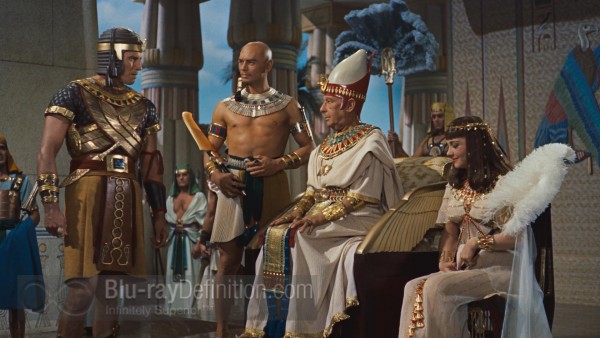
Left to Right: a soldier, Rameses II, Pharaoh Sethi, and Nefertiri

Parting of the Red Sea: amazing graphics for it's time!

I also reviewed this at Elegance of Fashion: Link!

Saturday, June 11, 2011

Movie: The King's Speech

My rating on a 1-10 scale: 9
Main characters: Prince Albert "Bertie" (Later to be King George VI), Elizabeth, Lionel Logue, David (Later to be Edward VIII)
Genre: Drama
Recognizable actors: Colin Firth, Geoffrey Rush, Helena Bonham Carter, Michael Gambon, Jennifer Ehle, Derek Jacobi
Length: 118 minutes
Based on: Real Life story on Prince Albert/George VI's stammer
Time period: 1930's, 1940's
Year it came out: 2010
Story: Prince Albert (or Bertie) has struggled his whole life with a stammer. His wife, Elizabeth, finds out about speech therapist Lionel Logue and Bertie starts to go to him.  Rated R
My overall opinion: Love this movie! Colin Firth's Best Actor Oscar is well deserved for his role as King George VI! There is some talk about a scandal and some swearing, but The King's Speech was very well acted and a great movie!
There may be some concern about the R rating, so I'll explain that now. It's rated R for language: one of the exercises Lionel has Bertie do to relieve stress is to use swears to relieve stress because when Bertie is angry, he stammers less; so Bertie unleashes a whole string of big swears that aren't aimed at anyone to relieve stress. The scene is fairly easy to see coming (the line "Do you know any swears?" makes it easy to spot). There is also another scene right before a big speech where there are a couple more swears dropped. Mainly, there are two scenes where the big swears are concentrated: the rest of the movie doesn't have too many swears in it.

Helena Bonham Carter as Queen Elizabeth (Future Queen Mum)

Elizabeth, Bertie, and Lionel during a speech exercise

Lionel, Myrtle Logue (Lionel's wife), and Bertie. Jennifer Ehle, known for her role as Elizabeth Bennet in Pride and Prejudice (1995), plays Myrtle and is in this picture with P&P co-star Colin Firth.

A table that I made for my review at Elegance of Fashion. The King's Speech did a really great job at making their actors look like their real life counterparts.
I've also reviewed this at Elegance of Fashion: Link!

Friday, June 10, 2011

The Jane Austen Handbook

The Jane Austen Handbook
A Sensible Yet Elegant Guide to Her World
(More recently published as: The Jane Austen Handbook: Proper Life Skills from Regency England)

Author: Margaret C. Sullivan

Genre: Non-fiction (presented in a witty way)

My rating on a 1-10 scale: 10

Number of pages: 224

Summary: Learning about life in the past couldn't be more enjoyable. Delightfully mixing information with entertainment, this illustrated book tells you what every Regency young woman should know – from becoming an accomplished lady to declining an offer of marriage. It’s divided into four sections, and has a very useful appendix in the back – including a list of all Jane Austen’s novels with a summary, and when they were written and published. It also includes a list of all the movies with year it was made, actors, etc. Then there is a helpful glossary that defines tricky words of the time, and a good index to help you find what you’re looking for. This book is essential to any young woman who has ever imagined herself to be a Jane Austen heroine!

My overall opinion: I have nothing but praise to say about this book. It’s one of the few non-fiction books that is great to read all the way through. I recommend it very highly to all Janeites – or anyone who likes Jane Austen, the time period, or old-fashioned things in general. More enjoyment can be drawn from it, however, if you do know something of Jane Austen’s stories. The authoress is constantly making indirect references to the books and characters – which you only catch if you know – and it’s very funny. I can’t say how many times I’ve started laughing out loud while reading it. I really love how at the beginning of each section of one of the ‘How To’s, there is a Jane Austen quote. The way everything is written is superb – I love the interesting choice of words and sentences, quite the opposite of boring.
   I was exceedingly glad to receive the book for my birthday – I had been borrowing a friend’s copy, and it’s so nice to have my own on hand. (By the way, the girls at my birthday party were having fun flipping through the book, laughing, and saying they needed to get one for themselves.)
    I know so much more now than I did before I read it (which wasn’t too small an amount.) I love knowing about things like the proper dress for first mournings and second mournings, what sort of meals were served at what times, paying calls…there’s so much in there!
    Oh dear! What a long opinion I’ve written. Well, what can I say? It was splendid! Highly recommended!

*Review by Melody*
Regency Delight --Jane Austen,etc.--

Thursday, June 9, 2011

Movie: Miss Austen Regrets


My rating on a 1-10 scale: 2
Main characters: Jane Austen, Fanny Austen-Knight, Cassandra Austen,
Genre: Drama
Recognizable actors: Olivia Williams, Greta Scacchi, Phyllida Law
Length: 90 minutes
Based on: Jane Austen's life and books
Time period: 1810's
Year it came out: 2008
My overall opinion: I did not like the way Jane Austen was protrayed in this movie. She was protrayed as someone who indulged in too much wine, flirted with any man in her path, and was always in constant ill-humor (which is not how I would picture Jane Austen). It seemed like she had some of the behaviors that the real Jane Austen would have condemned in her stories. It also seemed like whenever there was a quote from one of Jane Austen's novels, it didn't seem natural when it was said, like it was just bluntly inserted into the dialogue. And it seeemed that Jane cared more for Fanny getting a rich husband than one that she actually loved, which isn't like Jane at all; I've heard that she told Fanny to get a husband that could support her, but that she should not marry without love. However, the scenery and costumes were good (though I didn't like this turban thing that Jane wore for a lot of the movie): if you're looking for Regency Era dress ideas, here would be a good place to start. But I'm afraid that good costumes and good scenery aren't enough to save this movie.

Jane Austen at an evening with friends.

Fanny (right) and Jane (left) travelling. Didn't care for the turban headpiece Jane had...

Jane (foreground) with Cassandra Austen and Fanny in the background.


I also reviewed this at Elegance of Fashion: link!

Mini-series: Bleak House


My rating on a 1-10 scale: 8.5

Main characters: Esther Summerson, Ada Clare, Richard Carstone, John Jarndyce, Lady Dedlock (there are many characters)

Genre(s): Mystery, Drama

Primary actors: Anna Maxwell Martin, Carey Mulligan, Gillian Anderson

Filmmaker: BBC

Year: 2005

Length: 8 hrs. 30 min. (15 episodes)

Based on: the book by Charles Dickens

Time period: Mid-1800s

Exciting Events:  Murder, scandalous pasts uncovered, spontaneous combustion resulting in death, smallpox, & more.

Summary: “Charles Dickens' complex tale of young love, murder, and the quest for a mystery-man's identity unfolds in this adaptation by screenwriter Andrew Davies. Bleak House features some of the most famous plot twists in literary history, including a case of spontaneous human combustion and an inheritance dispute tied up for generations in the dysfunctional English courts.” (http://www.pbs.org/wgbh/masterpiece/bleakhouse/synopsis.html) (I usually write my own summaries, but I could foresee difficulties in attempting this one…the story is so complicated.)

Quotes: “Judy, shake me up!” –Mr. Smallweed
“They say he sold his soul to the devil. But if he did, I don’t know what he did with the money!” –Mr. Krook
Sir Leicester Dedlock: Is it still raining, my love?
Lady Dedlock: Yes, my love.
Sir Leicester: Remarkable.
Lady Dedlock: And I am bored to death with it. Bored to death with this place, bored to death with my life, bored to death with myself.
Sir Leicester: What was that, my love?
Lady Dedlock: Nothing! …Of consequence.
“I’m sorry I’m not quite the thing.” –Richard Carstone

My overall opinion: A very captivating and suspenseful mini-series – it kept me on the edge of my seat, and I probably finished it too quickly than was really good for me. I thought it had some creepy parts though, and like most Charles Dickens stories, I wasn’t exactly satisfied at the end. And a lot of people died! The romances weren’t exactly what I would have liked them to be, either. I felt sorry for Mr. Jarndyce, and even though he was so much older than Esther, I liked him - he was such a nice man. I liked enjoyed the costumes, and I liked Esther’s hair in the first half. (It reminded me of Margaret Hale’s in North and South, and I’ve tried to do it on myself.) Gross old Mr. Smallweed got on my nerves with his constant griping about his bones and shouting “Shake me up!” probably in all of his scenes, and usually to his granddaughter Judy. Mr. Skimpole was quite irritating with his constant declarations of being “like a child” (yeah, sure); but these characters are supposed to be annoying, so it’s all part of the story. ;-) Charles Dickens always chooses odd names, but as one of my friends observed, this one might top them off. “Tulkinghorn, Smallweed, Skimpole, Jarndyce, Guppy, Dedlock, Krook…” the list goes on.
     I recommend it as a very interesting mystery with an intricate plot, and well-made Dickens adaptation.

Trailer: (This trailer, to me, actually makes the movie seem less interesting than it actually is – plus, the main character is only shown a couple times.)


*Review by Melody*